
Al-Tayyibat Diet vs Carnivore: Key Differences for Beginners
If you are comparing the Al-Tayyibat Diet vs Carnivore, the biggest difference is simple:
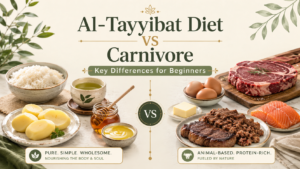
Carnivore focuses almost entirely on animal foods.
The Al-Tayyibat Diet focuses on pure, simple, recognizable foods — including both animal and non-animal staples.
Both approaches may attract people who are tired of ultra-processed foods, confusing diet advice, and long ingredient lists. But they are not the same system.
This guide explains the key differences between the Al-Tayyibat Diet and the Carnivore Diet, including food rules, plant foods, meat, pure foods, beginner safety notes, and which approach may fit different goals.
Quick Comparison: Al-Tayyibat Diet vs Carnivore
| Category | Al-Tayyibat Diet | Carnivore Diet |
|---|---|---|
| Main focus | Pure, simple, recognizable foods | Mostly or only animal foods |
| Core question | Is this food Tayyib or Khabeeth? | Is this food animal-based? |
| Plant foods | May include rice, potatoes, honey, green tea, and homemade bread | Usually excluded or heavily limited |
| Meat | Can be included as a strategic protein | Central foundation of the diet |
| Carbs | Not automatically rejected | Usually very low or near zero |
| Processed foods | Usually avoided if full of additives or seed oils | Usually avoided unless animal-based and simple |
| Goal | Food purity and reduced dietary friction | Animal-based elimination approach |
| Beginner risk | Can become too restrictive if misunderstood | Can be highly restrictive and may not suit everyone |
What Is the Al-Tayyibat Diet?
The Al-Tayyibat Diet is a pure food framework built around the difference between Tayyibat foods and Khabaith foods.
In simple terms:
Tayyibat foods are pure, simple, wholesome, recognizable, and easier to build meals around.
Khabaith foods are processed, industrially altered, full of additives, or difficult to recognize as basic ingredients.
Common beginner Tayyibat foods may include:
- White rice
- Peeled potatoes
- Pure ghee
- Butter
- Fresh beef
- Fresh lamb
- Fresh fish
- Honey
- Green tea
- Simple homemade meals
Common Khabaith foods may include:
- Industrial seed oils
- Commercial pastries
- Ultra-processed snacks
- Artificial additives
- Packaged foods with long ingredient lists
- Artificially flavored drinks
- Foods fried in vegetable oils
The Al-Tayyibat approach does not begin by removing all plant foods. It begins by asking whether a food is pure, simple, recognizable, and low in industrial processing.
What Is the Carnivore Diet?
The Carnivore Diet is a very restrictive eating pattern based mainly on animal foods.
Depending on the version, it may include:
- Beef
- Lamb
- Poultry
- Fish
- Eggs
- Animal fat
- Bone broth
- Some dairy, depending on the person
Many versions avoid or heavily restrict:
- Grains
- Rice
- Potatoes
- Bread
- Fruit
- Honey
- Legumes
- Vegetables
- Nuts
- Seeds
- Most plant foods
Some people use carnivore as an elimination diet, while others use it as a long-term animal-based eating pattern.
Because it removes many food categories, it should be approached carefully, especially by people with medical conditions.
Main Difference #1: Pure Food Framework vs Animal-Based Restriction
The Al-Tayyibat Diet asks:
Is this food pure, simple, recognizable, and low in industrial processing?
The Carnivore Diet asks:
Is this food animal-based?
This difference changes the entire structure of the diet.
For example, white rice, peeled potatoes, honey, and green tea may appear in the Al-Tayyibat system because they are simple and recognizable.
But they are usually excluded from strict carnivore because they are plant-based or carbohydrate-containing foods.
At the same time, a processed meat product may technically be animal-based, but it may not fit the Al-Tayyibat approach if it contains additives, preservatives, seed oils, fillers, or a long ingredient list.
Main Difference #2: Plant Foods
Plant foods are one of the clearest differences.
The Al-Tayyibat system may include certain plant foods when they are simple, recognizable, and suitable for the person.
Examples may include:
- White rice
- Peeled potatoes
- Honey
- Green tea
- Whole wheat flour for homemade bread
- Simple fruit preserves, depending on the context
The Carnivore Diet usually excludes plant foods or limits them heavily.
This makes carnivore much more restrictive for most beginners.
For someone whose culture or daily meals include rice, potatoes, tea, honey, or homemade bread, the Al-Tayyibat framework may feel more flexible.
Main Difference #3: Meat and Protein
Both systems may include animal foods.
But they use them differently.
In the Al-Tayyibat system, fresh meat, lamb, fish, and liver may be used as strategic proteins within a broader pure-food framework.
In carnivore, meat and animal foods are the central foundation of the entire diet.
This means carnivore may be simpler in one way, but more restrictive in another.
A beginner carnivore meal may be mostly meat and animal fat.
A beginner Al-Tayyibat meal may look like:
White rice + ghee + fresh beef + water
or:
Peeled potatoes + butter + fish + green tea
The Al-Tayyibat system does not require removing all non-animal foods.
Main Difference #4: Carbohydrates
Carnivore is usually very low in carbohydrates because it removes most plant foods.
The Al-Tayyibat Diet does not automatically reject carbohydrates.
Foods like rice, potatoes, honey, and homemade bread may appear in the system depending on the person and context.
This makes the Al-Tayyibat Diet very different from carnivore, keto, or other low-carb frameworks.
The Al-Tayyibat question is not:
Is this food zero-carb?
The question is:
Is this food pure, simple, recognizable, and lower in industrial processing?
Main Difference #5: Processed Animal Foods
Some animal-based products may be highly processed.
Examples may include:
- Processed deli meats
- Sausages with additives
- Meat snacks with preservatives
- Packaged cheese products
- Processed sauces used with meat
- Commercial fried meats cooked in seed oils
From an Al-Tayyibat perspective, animal-based does not automatically mean Tayyib.
A food still needs to be simple, recognizable, and low in additives.
Fresh lamb is very different from a packaged meat product with a long ingredient list.
Similarity #1: Both May Reduce Ultra-Processed Foods
The Al-Tayyibat Diet and Carnivore Diet may overlap in one useful way:
Both can lead people away from ultra-processed foods.
Both approaches may discourage:
- Packaged pastries
- Sugary snacks
- Artificially flavored drinks
- Ultra-processed junk foods
- Foods with long ingredient lists
- Industrial seed oils
However, the reason is different.
Carnivore avoids many of these because they are not animal foods.
The Al-Tayyibat system avoids them because they are often Khabaith: processed, additive-heavy, industrially altered, or difficult to recognize as basic ingredients.
Similarity #2: Both Can Be Misused
Both systems can become risky if taken to extremes.
The Al-Tayyibat Diet can be misused if someone becomes afraid of too many foods, removes major food groups unnecessarily, or under-eats.
Carnivore can be misused if someone removes nearly all plant foods without understanding their health needs, digestion, medication situation, or nutrient requirements.
No diet should become a reason to ignore your body, stop medication, or avoid qualified medical guidance.
Which Is Easier for Beginners?
This depends on the person.
The Al-Tayyibat approach may feel easier for beginners who want to:
- Keep some traditional staples
- Avoid ultra-processed foods
- Build simple meals
- Eat rice or potatoes
- Use honey or green tea
- Avoid complicated tracking
Carnivore may feel easier for people who prefer very strict rules and want a narrow food list.
But for many beginners, carnivore may feel too restrictive because it removes nearly all plant foods.
A less extreme first step may be to simplify your food environment before removing entire food categories.
Which Is Better for Weight Loss?
It is not responsible to say that one system is automatically better for weight loss for everyone.
Carnivore may lead to weight loss for some people because it removes many food categories and may reduce appetite.
The Al-Tayyibat system may support better food habits for some people by reducing ultra-processed foods, seed oils, packaged snacks, and confusing ingredient lists.
But weight change depends on many factors, including:
- Total food intake
- Protein intake
- Activity level
- Sleep
- Stress
- Medical history
- Hormones
- Medication
- Consistency
- Individual metabolism
Neither approach should be presented as a guaranteed weight loss solution.
Which Is Better for Digestion?
Digestion is individual.
Some people feel better with simpler meals.
Some people feel better reducing certain plant foods.
Some people do not tolerate high-fat animal-based meals well.
Others may not tolerate rice, dairy, honey, potatoes, or certain meats.
The best beginner approach is to pay attention to your body without making extreme claims.
Track:
- Bloating
- Energy
- Digestion
- Hunger
- Sleep
- Mood
- Food tolerance
If symptoms worsen, slow down and seek professional guidance.
Safety: Who Should Be Careful?
Both the Al-Tayyibat Diet and Carnivore Diet require caution for certain people.
Speak with a qualified healthcare professional before starting either approach if you:
- Have diabetes
- Take prescription medication
- Are pregnant or breastfeeding
- Have kidney disease
- Have liver disease
- Have cardiovascular disease
- Have a history of eating disorders
- Have food allergies
- Have autoimmune disease
- Follow a medically restricted diet
- Are underweight or recovering from illness
This is especially important for carnivore because it can be highly restrictive and may affect digestion, nutrient intake, cholesterol markers, kidney concerns, medication needs, and eating patterns.
It is also important for the Al-Tayyibat Diet if someone plans to remove major food groups or make big changes quickly.
Which Approach Fits You Better?
The Al-Tayyibat Diet may fit you better if you want to:
- Focus on food purity and simplicity
- Avoid ultra-processed foods
- Keep simple staples like rice or potatoes
- Learn the Tayyibat vs Khabaith framework
- Build meals without removing all plant foods
- Start with a gentler food simplification approach
Carnivore may fit you better if you specifically want to:
- Follow an animal-based elimination diet
- Remove nearly all plant foods
- Focus mainly on meat and animal foods
- Use a highly restrictive framework
- Work under guidance for a specific reason
Neither approach should be chosen because of hype alone.
The right approach depends on your health history, food tolerance, goals, culture, and ability to follow the system safely.
A Beginner-Friendly Middle Ground
If you are unsure, you do not need to jump into a strict diet immediately.
A more balanced first step is to simplify your food environment.
Start with:
- Removing industrial seed oils
- Avoiding ultra-processed snacks
- Cutting commercial pastries
- Reading ingredient labels
- Choosing basic homemade meals
- Eating enough food
- Paying attention to your body
This can help improve food quality without immediately committing to a highly restrictive plan.
Download the Free Al-Tayyibat Starter Kit
If you want to explore the Al-Tayyibat approach, start with the free beginner guide.
It includes:
- Beginner food list
- Tayyibat vs Khabaith quick guide
- First grocery run checklist
- 3-day starter meal framework
- Common beginner mistakes
- Safety notes before starting
Download it here:
Get the Full Al-Tayyibat System Book
The full book goes deeper into the complete Al-Tayyibat framework and includes the 7-Day Reset, 21-Day Protocol, food lists, shopping guidance, meal frameworks, common mistakes, and troubleshooting for beginners.
Learn more here:
Related Guides
Read these next:
How to Start the Al-Tayyibat Diet in 7 Days
Final Thoughts
The Al-Tayyibat Diet and Carnivore Diet are very different.
Carnivore begins with animal-based restriction.
The Al-Tayyibat Diet begins with food purity, simplicity, and the difference between Tayyibat and Khabaith foods.
Carnivore asks whether a food is animal-based.
The Al-Tayyibat system asks whether a food is pure, simple, recognizable, and low in industrial processing.
For beginners, the best choice is not the most extreme one. It is the one you can approach safely, clearly, and responsibly.
Medical Disclaimer
This article is for educational purposes only and does not provide medical advice, diagnosis, or treatment. Always consult a qualified healthcare professional before changing your diet, especially if you have a medical condition, take medication, are pregnant or breastfeeding, have diabetes, or have another chronic condition.
About the Author
This article was reviewed and published by the Tayyibat Diet Guide Editorial Team.
Learn more about our editorial team here.