
Diabetic Coma: Dr. Diaa Al-Awadi’s Perspective Explained
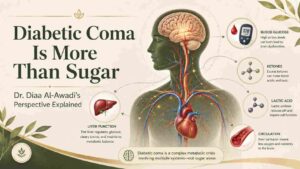
Diabetic coma is often explained in a simple way:
Blood sugar becomes too high, the body loses control, and the patient may lose consciousness.
Diabetic coma is a serious medical emergency, but Dr. Diaa Al-Awadi argued that it should not be understood as high blood sugar alone.
His main idea was that diabetic coma is not only about a high glucose level. He presented it as a wider crisis involving blood acidity, ketones, lactic acid, liver congestion, circulation, oxygen delivery, and whether fuel is actually reaching the brain and tissues.
This article explains that perspective in beginner-friendly language, while also making one point very clear:
Diabetic ketoacidosis, hyperosmolar crisis, severe acidosis, and altered consciousness are medical emergencies. This article is educational only and is not a treatment guide.
In this guide:
- What diabetic coma usually means
- Why high blood sugar is not the only factor
- The role of acidosis and ketones
- Dr. Diaa Al-Awadi’s view of liver congestion and circulation
- Medical warning signs and safety notes
Important Medical Safety Note
If someone has diabetes and develops confusion, extreme weakness, vomiting, deep or rapid breathing, severe dehydration, abdominal pain, fruity-smelling breath, fainting, or reduced consciousness, seek emergency medical care immediately.
Modern medical consensus treats diabetic ketoacidosis and hyperosmolar hyperglycemic state as life-threatening emergencies. Current consensus guidance describes the main treatment pillars as fluid replacement, insulin therapy, electrolyte replacement, and treatment of the underlying trigger.
Do not use this article to delay emergency care, stop prescribed medication, avoid insulin, or self-treat a diabetic crisis.
This article uses the phrase diabetic coma in a beginner-friendly way to discuss severe diabetic crises, including diabetic ketoacidosis, hyperosmolar hyperglycemic state, severe acidosis, and reduced consciousness. The goal is education, not diagnosis or treatment.
The Usual Explanation of Diabetic Coma
In conventional teaching, serious hyperglycemic crises are often grouped into major patterns, especially:
- Diabetic ketoacidosis, often called DKA
- Hyperosmolar hyperglycemic state, often called HHS
- Other forms of metabolic acidosis, including lactic acidosis in certain contexts
The common beginner explanation usually focuses on insulin:
When insulin is absent or insufficient, glucose cannot properly enter cells, blood sugar rises, fat breakdown increases, ketones build up, blood becomes acidic, and the patient may deteriorate.
Dr. Al-Awadi did not deny that glucose, insulin, ketones, and acidosis are involved. But his lecture challenged the idea that the whole story can be reduced to “high sugar alone.”
The Three Patterns He Highlighted
In the lecture, Dr. Al-Awadi emphasized that not every diabetic crisis looks the same.
He described three broad patterns:
- High blood sugar with coma but without clear acidosis or ketones
- High blood sugar with acidosis but without ketones
- High blood sugar with acidosis and ketones
He used this comparison to argue that sugar alone cannot explain every form of deterioration. In his view, the presence or absence of acidosis and ketones points toward deeper problems in circulation, liver handling of acids, tissue fuel delivery, and metabolic congestion.
This is the central idea of the lecture:
The glucose number is only one finding. It is not the entire crisis.
Why Acidosis Matters
Acidosis means the blood has become too acidic.
In diabetic ketoacidosis, ketones contribute to acidosis.
But Dr. Al-Awadi highlighted that acidosis can also happen without ketones, such as in lactic acidosis. In the lecture, he discussed lactic acid, pyruvate, the Cori cycle, and the liver’s role in converting metabolic byproducts back into glucose. He also mentioned that some medications or liver-related problems may affect this process.
This matters because it shifts the question from:
Why is the sugar high?
to:
Why is the body accumulating acids, failing to clear metabolic byproducts, or failing to deliver energy properly?
That is a much wider biological question.
Ketones Do Not Always Mean High Sugar
Another key point in the lecture was that ketones and ketoacidosis can appear in situations where blood sugar is not extremely high.
He mentioned fasting, severe physical exertion, starvation-like states, and SGLT2 inhibitor drugs as examples where ketoacidosis may occur with normal or lower glucose levels.
This point is important because it overlaps with a recognized medical issue: euglycemic ketoacidosis, especially in relation to SGLT2 inhibitors. FDA labeling for some SGLT2 inhibitor medications warns that blood glucose may be normal even when ketoacidosis is present, and patients with symptoms such as nausea, vomiting, abdominal pain, tiredness, or labored breathing should seek medical attention.
So, even within mainstream medicine, it is true that dangerous ketoacidosis does not always require extremely high blood sugar.
Dr. Al-Awadi’s Bigger Question
Dr. Al-Awadi’s lecture repeatedly returned to a broader question:
If sugar is high in the blood, is it actually reaching the tissues that need it?
He argued that a person can have high blood sugar in the bloodstream while still having poor tissue delivery because of circulation problems, blood pooling, liver congestion, inflammation, or poor perfusion.
In his view, coma is not simply the result of “too much sugar.” It may reflect a failure of delivery: blood, oxygen, glucose, and ketone fuel may not be reaching the brain properly.
He connected this to ideas such as:
- Poor peripheral circulation
- Reduced brain perfusion
- Liver congestion
- Splanchnic blood pooling
- Hyperdynamic circulation
- Poor oxygen delivery in the lungs
- Accumulation of lactate, pyruvate, fatty acids, and ketones
This is why he framed the crisis as a circulation-and-metabolism problem, not only a glucose problem.
The Liver as a Central “Metabolic Station”
A major theme in the lecture is the liver.
Dr. Al-Awadi described the liver as a central station that receives substances from the gut and body, processes them, and releases new metabolic products back into circulation.
In simplified terms, he described the liver as involved in:
- Converting lactate and pyruvate into glucose
- Processing amino acids and nitrogen compounds
- Producing glucose through gluconeogenesis
- Producing ketone bodies from fatty acids
- Helping regulate blood chemistry after meals
His argument was that if the liver becomes congested, inflamed, or functionally overloaded, this entire system can become backed up.
In his framework, liver congestion may help explain why some patients show high sugar, acidosis, ketones, altered breathing, poor circulation, or reduced consciousness.
The Gut–Liver Connection
Dr. Al-Awadi also connected the crisis to the digestive system.
He argued that wrong food choices, gut irritation, histamine, gastrin, abdominal pressure, and intestinal congestion may affect blood distribution and liver load.
This connects with the broader Al-Tayyibat philosophy, which focuses on reducing processed foods, simplifying meals, and avoiding foods seen as high-friction or difficult for the gut and liver to handle.
From this perspective, the digestive system is not separate from blood sugar.
It is part of the same metabolic network.
The gut sends blood to the liver through the portal circulation. If digestion is overloaded, the theory suggests that the liver and circulation may also become stressed.
Why He Criticized a Sugar-Only View
The lecture criticizes a narrow focus on lowering blood sugar numbers without asking why the body is in crisis.
His concern is that if doctors or patients focus only on reducing glucose, they may miss other questions:
- Is the patient acidotic?
- Are ketones present?
- Is lactate elevated?
- Is the liver congested or overloaded?
- Is the brain receiving enough blood and fuel?
- Is oxygen delivery impaired?
- Is a medication contributing?
- Is there infection, inflammation, or digestive overload?
- Is the patient dehydrated or poorly perfused?
This does not mean glucose is unimportant.
It means glucose is one part of a larger emergency picture.
A Careful Note About Treatment Claims
In the lecture, Dr. Al-Awadi discusses his own ideas about circulation, corticosteroids, liver congestion, and crisis management. However, for a public educational website, we must be very careful.
This article does not recommend replacing standard emergency care.
Modern medical guidelines for diabetic ketoacidosis and hyperosmolar crisis still emphasize emergency assessment, fluids, insulin when indicated, electrolyte management, monitoring, and treating the underlying cause.
If someone is in a diabetic crisis, this is not a situation for home experiments, diet changes, or internet protocols.
It is an emergency.
What Beginners Can Safely Learn From the Lecture
The safest takeaway is not a treatment protocol.
The safest takeaway is a broader way of thinking:
Blood sugar is important, but it is not the only marker of metabolic health.
A person’s metabolic state may also involve:
- Hydration
- Electrolytes
- Ketones
- Acidity
- Lactate
- Liver function
- Kidney function
- Circulation
- Oxygen delivery
- Medication effects
- Food quality
- Digestive stress
- Inflammation
That is a useful educational insight.
It encourages people to avoid oversimplifying complex medical emergencies.
How This Connects to the Al-Tayyibat Diet
The Al-Tayyibat Diet is built around the idea that food should be simple, pure, recognizable, and easier for the body to process.
In the context of this lecture, the connection is clear:
Dr. Al-Awadi’s wider philosophy is not only about “eat this, avoid that.” It is about reducing biological friction.
That means paying attention to:
- Food processing
- Digestive burden
- Seed oils
- Additives
- Long ingredient lists
- Meal complexity
- Gut comfort
- Liver load
- Energy delivery
- How the body responds after meals
This is why many Al-Tayyibat beginner guides focus on simple foods such as rice, potatoes, ghee, butter, fresh protein, honey, green tea, and homemade meals.
But again, if someone has diabetes, medication use, blood sugar problems, or a history of diabetic emergencies, dietary changes must be discussed with a qualified healthcare professional.
What This Article Does Not Say
This article does not say:
- High blood sugar is harmless
- Insulin is never needed
- DKA can be treated at home
- Corticosteroids should be used without medical supervision
- Medication should be stopped
- Diet can replace emergency care
- Diabetic coma is simple
- One theory explains every patient
The correct approach is humility.
Diabetic crises are complex, dangerous, and individual.
Diabetic Coma: A Beginner-Friendly Summary
Dr. Diaa Al-Awadi’s lecture can be summarized like this:
Diabetic coma should not be reduced to sugar alone.
His perspective highlights that different crisis patterns may involve high glucose, acidosis, ketones, lactate, liver congestion, poor circulation, poor tissue fuel delivery, and reduced brain perfusion.
That does not replace emergency medicine.
But it does challenge beginners to understand that blood sugar is only one part of a much larger metabolic system.
Diabetic Coma Warning Signs: When to Seek Emergency Help
Seek urgent medical care if a person with diabetes or suspected metabolic crisis has:
- Confusion
- Fainting
- Reduced consciousness
- Deep or rapid breathing
- Vomiting
- Severe weakness
- Severe dehydration
- Abdominal pain
- Fruity-smelling breath
- Chest pain
- Severe infection symptoms
- Blood sugar very high or very low
- Ketones with illness or symptoms
- Symptoms while taking SGLT2 inhibitor medication
Do not wait for symptoms to “settle.”
Download the Free Al-Tayyibat Starter Kit
If you want to understand the food philosophy behind the Al-Tayyibat approach, download the free Al-Tayyibat Starter Kit.
It includes:
- Beginner food list
- Tayyibat vs Khabaith quick guide
- First grocery run checklist
- 3-day starter meal framework
- Common beginner mistakes
- Safety notes before starting
Download it here:
Get the Full Al-Tayyibat System Book
The full book goes deeper into the complete Al-Tayyibat framework and includes food lists, shopping guidance, meal frameworks, common mistakes, and practical troubleshooting for beginners.
Learn more here:
Related Guides
Read these next:
Al-Tayyibat Diet and Histamine
Final Thoughts
The lecture’s most valuable message is not that sugar does not matter.
Sugar matters.
But a diabetic crisis is bigger than one number.
The body is a connected system: gut, liver, blood, oxygen, acids, ketones, hormones, circulation, brain perfusion, medications, and food quality all interact.
That is why diabetic coma is more than sugar.
It is a whole-body emergency.
And whole-body emergencies require professional medical care.
Medical Disclaimer
This article is for educational and informational purposes only. It does not provide medical advice, diagnosis, or treatment. Diabetic ketoacidosis, hyperosmolar hyperglycemic state, severe acidosis, severe dehydration, altered consciousness, and suspected diabetic coma are medical emergencies. Always seek immediate medical care for urgent symptoms and consult a qualified healthcare professional before changing diet, medication, insulin, or diabetes management.